Machine: The Steampunk Typeface That Builds Worlds
There's a moment in every designer's search for the perfect typeface when you need something that does more than just spell out words. You need a font that tells a story, that transports your audience to another time and place. That's where Machine comes in. This isn't just a collection of letters; it's a fully realized industrial artifact, a premium font that looks like it was forged in a Victorian foundry and polished for a high-tech future.
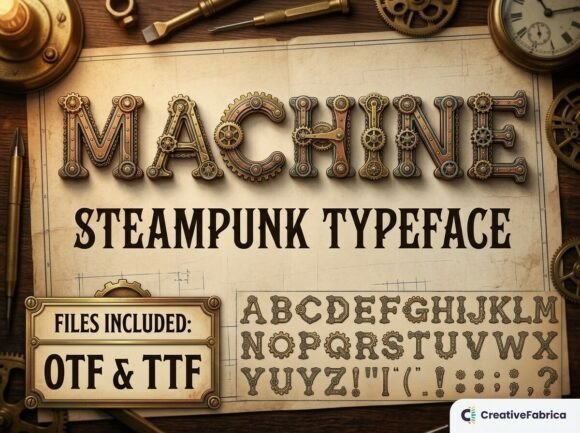
At its core, Machine is a display font built on a foundation of steampunk aesthetics. Imagine each character not as a simple stroke, but as a complex assembly. The serifs aren't just decorative—they resemble sturdy iron plates. The counters (the enclosed spaces in letters like 'O' and 'D') are filled with intricate, visible mechanisms. You'll find gears where you'd expect joints, cogs integrated into the curves, and rivets dotting the terminals. The realistic 3D texture and metallic finish give it a tangible, weighty presence, as if you could reach out and feel the cold, brushed steel. It has the personality of a serif font—authoritative and structured—but with an unmistakable mechanical flair that sets it apart from any traditional typeface.
Where This Industrial Font Truly Shines
The strength of Machine lies in its ability to immediately establish a specific genre or mood. It's a specialist, and when used in the right context, it's unparalleled. Think about projects that need to evoke a sense of craftsmanship, alternate history, or retro-futurism.
- For Publishers and Authors: It's the obvious, yet perfect, choice for the title treatment on a sci-fi novel cover, especially within the steampunk or dieselpunk subgenres. It instantly signals the book's world to potential readers browsing a shelf or online store.
- For Game Designers and Developers: Use it for high-fantasy RPG headers, menu titles, or in-game signage. It sets the tone for a world powered by steam and clockwork, enhancing player immersion from the first screen.
- For Event Organizers and Marketers: Designing flyers for a steampunk convention or a vintage industrial fair? Machine is your cornerstone. It builds instant recognition for the event's theme.
- For Brand Strategists and Entrepreneurs: If your business is a craft brewery, a bespoke tailor, a maker space, or a specialty coffee roaster with a vintage industrial vibe, this typeface can be a powerful part of your brand identity. It communicates precision, durability, and old-world quality.
It’s less suited for body text or minimalist corporate branding, where its detail would become a distraction. Its job is to be the bold, declarative headline that draws you in.
Practical Guidance for Designers and Creators
Choosing a creative font like Machine requires a bit more consideration than picking a standard sans serif font. Here’s how to integrate it effectively into your workflow.
Evaluating Project Fit
Ask yourself: Does my project benefit from a strong, mechanical, or historical narrative? If you're designing a sleek tech startup's logo, probably not. But if you're creating the branding for a clockwork-themed escape room or packaging for artisanal gears, it’s a stellar match. The font itself does a lot of the heavy lifting in establishing visual hierarchy and mood.
Mastering Font Pairings
This is key. Machine is a dominant, high-contrast display font. Pairing it with another ornate typeface would create visual chaos. The best approach is to let it be the star. Pair it with a clean, simple, and highly readable sans serif font or a neutral serif font for any supporting text. Think of it like using a bold architectural element in a room—it needs simpler furnishings around it to stand out properly. For example, use Machine for your main headline, and a font like Roboto or Lato for subtitles and body copy. This creates a clear visual hierarchy that guides the reader's eye.
Considering Readability and Application
As with any detailed display typeface, readability at small sizes is a concern. It’s designed for impact at larger scales—think titles, logos, and pull quotes. Testing it at the intended final size is non-negotiable. In web design, you might use it for a hero section headline but not for navigation menus. In editorial design, it’s perfect for a chapter opener but not for running footnotes. For social media graphics, it can make a post instantly stand out in a fast-scrolling feed, but ensure the core message remains legible.
Leveraging Included Styles and Licensing
A premium font like Machine often comes with more than just the basic uppercase. Check if it includes alternates, ligatures, or stylistic sets. These features can add even more customization and uniqueness to your work. Furthermore, always review the commercial font license. If you're using it for a client project, a product for sale (like a T-shirt template), or a wide-reaching marketing campaign, you need to ensure the license covers that use. It’s a mark of professionalism to get this right.
In a world saturated with generic modern typography, Machine offers a distinct voice. It’s a design asset that can transform a mundane project into an immersive experience, bridging the gap between the gritty ingenuity of the past and the imaginative possibilities of the future. When your project calls for that specific blend of history, mechanics, and fantasy, this typeface is the tool that will build it for you.